



The insurance industry is undergoing a fundamental transformation. What was once a risk-averse sector defined by static pricing and historical loss experience is now evolving into a highly dynamic, data-driven ecosystem powered by predictive analytics and artificial intelligence (AI). At the heart of this transformation is the ability to anticipate outcomes before they happen—turning uncertainty into actionable insight. This evolution isn’t just about technology; it’s about reshaping the value proposition of insurance for carriers, brokers, and policyholders alike.
1. Real-Time Insight Becomes the New Standard
For decades, insurers relied on historical data and traditional actuarial techniques to set rates and manage claims. Today, predictive modeling and machine learning are rewriting that playbook. Models move beyond static risk segmentation to real-time, dynamic risk assessment that evolves with policyholder behavior, environmental conditions, and market shifts. Insurers can now anticipate when a loss is likely to occur, enabling proactive interventions that reduce claims and strengthen portfolios. (Insurance Thought Leadership)
2. IoT & Connected Devices Fuel a Sea of New Data
The increase of connected devices—from telematics in cars to sensors in homes and wearables tracking personal health—ushers in a data rich era. The insurance industry is uniquely positioned to harness this data to refine risk models continuously, offer usage-based insurance, and price coverage on a highly individualized basis. Instead of static premium tables, insurers will increasingly use live telematics and sensor feeds to update pricing models in real time. (Digital Insurance)
This shift not only sharpens risk selection but also opens the door to preventive insurance models where carriers and policyholders collaborate to avert losses before they occur.
3. AI Goes Beyond Efficiency to Strategic Decision-Making
The first wave of AI in insurance focused on automating repetitive tasks like claims triage or customer service. The next wave goes deeper: AI models are developing into strategic partners in underwriting, pricing, and portfolio management.
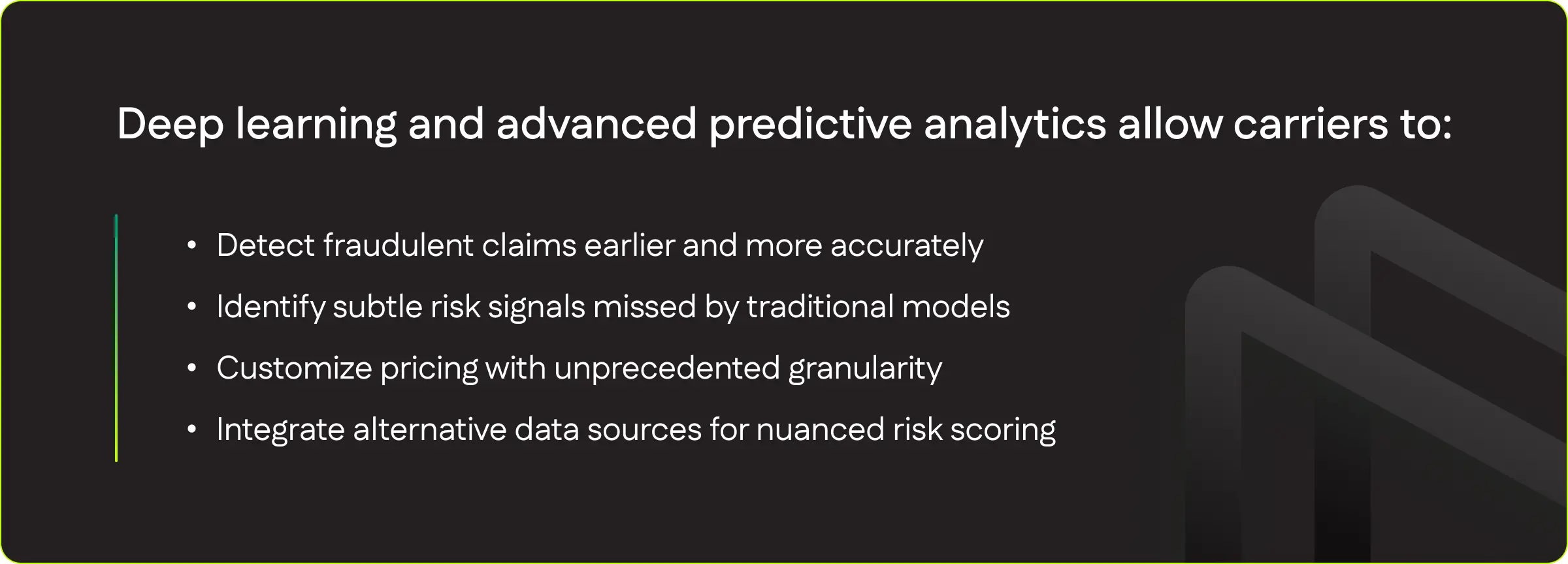
This evolution turns analytics from a back-office function into a core driver of competitive advantage. (The Deal Brief – Insurance)
4. Climate Change Modeling Becomes Mission-Critical
Climate volatility is one of the most pressing challenges facing property and casualty insurance. Traditional models often fail to capture the increasing frequency and severity of extreme weather events. Next-generation modeling must integrate climate science, remote sensing data, and machine learning to forecast evolving peril landscapes. Carriers that adopt AI-enhanced climate risk analytics not only improve pricing accuracy but also build long-term resilience into their product offerings.
5. Open Data and Ecosystem Collaboration
Insurers are beginning to unlock value from data outside their own silos. Open data initiatives and secure data sharing models—with robust privacy protections—will expand insurers’ ability to evaluate risk holistically. Whether it’s mobility data for auto risk or municipal climate data for property insurance, open ecosystems make risk models richer and more predictive.
Future industry success depends on interoperable data platforms that allow insurers, reinsurers, regulators, and partners to share intelligence—under strict compliance and governance frameworks.
6. Ethical, Explainable AI Takes Center Stage
AI’s rapid ascent brings legitimate concerns around fairness, transparency, and regulatory compliance. As models grow more complex, insurers must deploy explainable AI that stakeholders—regulators, agents, policyholders—can understand and trust. Explainability isn’t just a compliance checkbox; it’s essential for building confidence in automated decisions that materially affect pricing and claims outcomes.
7. What to Watch in the Next 3–5 Years
- Hyper-Personalized Insurance Products: Tailored coverage and pricing that reflect individual behavior and risk profiles.
- Federated and Privacy-Preserving Analytics: Secure modeling on distributed data without compromising privacy.
- AI-Augmented Workforce: Human expertise combined with AI insights will redefine underwriting and claims decision-making.
- Climate and Catastrophe Forecasting at Scale: Integration of geospatial, weather, and loss data to optimize reserves and capital planning.
Data Governance and Regulatory Innovation: Frameworks for ethical data use, model validation, and explainability will evolve alongside technology adoption.
Pinpoint’s Vision: Predicting Profitability Before Risk Matures
At Pinpoint, we believe the future of insurance lies in predictive precision. Combining deep actuarial expertise with advanced AI and scalable modeling, we empower carriers to make sharper, faster decisions across underwriting, pricing, marketing, and claims. Our approach anticipates risk early in the journey—unlocking insights before a policy is bound or a claim is filed.
If you’re looking to strengthen loss ratios, sharpen underwriting decisions, and build AI-driven resilience into your business, book a discovery call to explore how Pinpoint can help you stay ahead of risk